
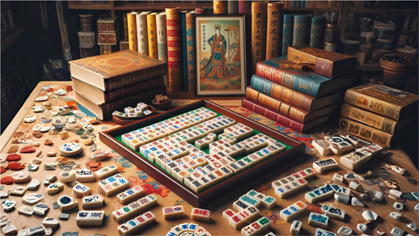
Picture, if you will, the hazy ambiance of 19th-century Shanghai tea houses—smoke curling around the murmur of animated merchants and scholarly chatter. Here, in these vibrant enclaves, Mahjong was no somnolent relic but rather a bold social experiment sprung forth from the crucible of China’s cultural amalgam. Its precise origins dissolve like mist—a tantalizing memory of the late Qing Dynasty—morphing slowly from rudimentary card games such as Madiao that employed flimsy paper suits, into a sophisticated pastime.
By the 1860s, artisans in Ningbo began meticulously etching bamboo and bone into distinct tiles, forging a novel game that interlaced the strategic nuances of dominoes, the calculated gambits of chess, and the impetuous allure of gambling.
The Sparrow’s Song: How Mahjong Got Its Name
Listen to the rhythmic clatter of tumbling tiles—a staccato that eerily echoes the soft, ceaseless chirps of sparrows. It is no mere coincidence. The Mandarin epithet “Ma Que” (sparrow) appears to have whispered its way into the game’s very identity, though the annals of lore sometimes grant its naming to Confucius himself.
One fanciful legend even posits that the sage concocted Mahjong out of an abiding fondness for birds; yet such a tale is often relegated to the realm of myth by discerning scholars. Instead, the game’s real ascent unfolded amid the chaotic embrace of treaty ports like Shanghai after the turbulent Opium Wars—a period marked by frenetic exchanges between foreign traders and local denizens, where the convergence of old-world ritual and modern dynamism gave birth to a pastime as unpredictable and layered as the era itself.
Westward Bound: Mahjong Crosses Oceans
By the 1920s, Mahjong mania had reached New York’s Park Avenue. Credit Joseph Babcock, an American oilman who discovered the game in China. Seeing dollar signs, he stripped its complex rules into a 40-page pamphlet, slapped on the exotic name “Mah-Jongg,” and sold sets in lavish boxes.
The marketing worked too well. Flappers ditched bridge clubs for Mahjong nights, while department stores like Abercrombie & Fitch (yes, that Abercrombie) peddled sets for a small fortune. But Babcock’s watered-down version sparked outrage in China. Purists sneered at his “Westernized” tiles, like adding Roman numerals to the Bamboo suit.
Yet the craze stuck, especially among Jewish-American women, who turned weekly games into rituals—complete with themed snacks and gossip.
Bans and Resurrections: Mahjong’s Political Rollercoaster
For decades, Mahjong was China’s guilty pleasure. But when Mao’s Communists took power in 1949, they branded it a “bourgeois vice.” Tiles were burned in streets; players risked fines or worse. Yet, like dandelions through concrete, the game survived. Families hid sets under floorboards, playing whispers after curfew.
The ban lifted in 1985, and Mahjong roared back—this time as a national treasure. Today, parks echo with the sound of retirees slamming tiles, while teens stream competitive matches online.
More Than a Game: Symbols in Every Tile
Every Mahjong tile whispers a story. The Red Dragon isn’t just a scoring piece—it’s a nod to imperial power. The Winds (East, South, West, North) reflect Confucian ideals of harmony. Even the suits carry weight: Bamboos symbolize resilience, Circles represent coins (prosperity), and Characters evoke scholarly ambition.
This symbolism turned Mahjong into a cultural language, one that Japanese and Korean players later adapted. In Japan, “Riichi Mahjong” added anime flair and gambling stakes, while American Jews invented their own National Mah Jongg League, complete with annual rulebooks and charity tournaments.
Why We Still Play: The Timeless Allure
Mahjong’s magic lies in its shape-shifting nature. In Shanghai alleys, it’s a high-stakes gamble; in Miami retirement homes, it’s a social lifeline. The game bends to its players, whether they’re Taiwanese grandparents teaching grandkids or Brooklyn moms swapping parenting tips between rounds.
It’s not just the thrill of a winning hand—it’s the way tiles become a bridge between generations, a shared code that says, “We’re here, together.” So next time you hear that familiar clatter, remember: You’re not just playing a game. You’re keeping a rebellious, ever-evolving story alive.